
Followers are not quality
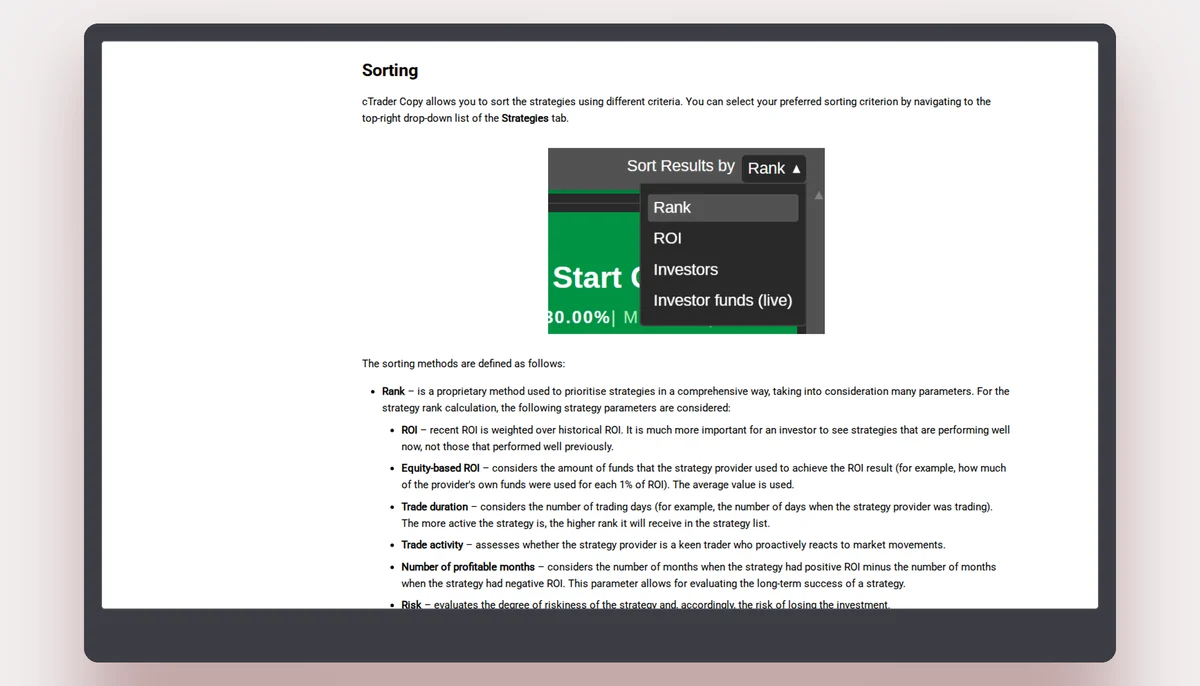
The public cards print no follower count. The help page does name counts of investors and amounts of funds, and it lists them among the inputs of the platform’s own Rank. This page says only that, defines the counts, and sets out why a count is a different kind of number from a measure of risk.
What the cards print
The cards on the symbol pages print a nickname, a strategy name, symbols, a return and an age label, and draw a small curve. They print no number of investors and no amount of funds. This site therefore has no follower count for any card and gives none. The strategy page, per the help page, summarises “Investor funds attracted by the strategy” and the “Number of investors copying the strategy” at its head; that page is inside the application.
Five counts that sound alike
The help page defines several. “Investors” is the number of investors copying the strategy now. “Active live investors” are those copying on live accounts, and “Active demo investors” those on demo accounts. “Investors over all time” is the total who have ever copied the strategy since it was created. “Investor funds (live)” is the amount currently copied by live accounts. For a provider the page lists “Total investor funds (live)” across all the provider’s strategies. Each answers a different question, and the help page does not say when any investor arrived or how large an investor’s share is.
The twelve inputs of the platform’s Rank, as its help page lists them, read on 6 November 2026
Source: help.ctrader.com/ctrader-copy/account-and-strategy-page, section “Sorting”. The page calls Rank “a proprietary method used to prioritise strategies in a comprehensive way, taking into consideration many parameters” and lists these twelve. The wording in the right column is the help page’s own; the page gives no weights and no formula.
| Input named by the help page | What the help page says about it |
|---|---|
| ROI | “recent ROI is weighted over historical ROI” |
| Equity-based ROI | “considers the amount of funds that the strategy provider used to achieve the ROI result” |
| Trade duration | “considers the number of trading days”; the more active, the higher the rank |
| Trade activity | “assesses whether the strategy provider is a keen trader who proactively reacts to market movements” |
| Number of profitable months | “considers the number of months when the strategy had positive ROI minus the number of months when the strategy had negative ROI” |
| Risk | “evaluates the degree of riskiness of the strategy and, accordingly, the risk of losing the investment” |
| Equity drawdown | “the lower the equity drawdown of a strategy is, the higher the strategy will show in the rank” |
| Risk reward | “the higher the risk-reward ratio of a strategy is, the higher the strategy will show in the rank” |
| Invested funds | “the more live investors’ funds are invested, the higher the strategy will show in the rank” |
| Number of live investors | “the more live investors that are copying a strategy, the higher the strategy will show in the rank” |
| Own funds | “the more funds the strategy provider invests in their own strategy, the higher the strategy will show in the rank” |
| Fees | “strategies that apply management fees and volume fees are downgraded in the rank calculation” |
What the list shows, and what this site does with it
Two of the twelve inputs concern the crowd of followers: Invested funds and Number of live investors. A third, Own funds, is the provider’s money on the strategy account. The other nine are about returns, activity, risk, drawdown and fees. The page also lets the strategy list be sorted by Rank, by ROI, by Investors or by Investor funds (live), and filtered by, among others, live investors number and investor funds. The platform ranks by its own method. This site does not rank by that method or by any other, shows no ordering of providers and takes no input from the Rank.
A count and a risk are separate numbers
In the help page’s list, Risk and Equity drawdown are inputs of their own, apart from the two that count investors. The platform therefore treats how many investors copy a strategy and how risky the strategy is as different quantities. A reader can do the same. A count is a snapshot of today’s copying; “Investors over all time” counts everyone who ever copied; neither says how the investors fared or what they paid.
What a follower’s size depends on
In the copying model the size of a copied trade is set by the ratio of the investor’s equity to the provider’s equity. It does not depend on how many others copy. What does depend on the provider’s own account is the ratio itself: the help page’s second example gives a provider “Own funds: USD 100,000” and a minimum investment of USD 100. Since the provider’s funds can move with deposits and withdrawals, the help page warns that these can change the open positions of everyone who copies.
What to read instead of a count
Within the platform’s own list of statistics, the items that describe the provider’s account rather than the crowd are the equity chart, the maximum balance drawdown, the starting balance, deposits and withdrawals, and the two “Active since” dates. All of them are on the strategy page. A follower count describes who is watching; these describe the account that is being copied.
In brief
Read next
Questions about reading a record
How many followers do the cards show?
None. The cards print no follower count, and this site does not state one for any card.
Does the platform use follower counts to order its list?
Its help page lists Invested funds and Number of live investors among the twelve inputs of Rank. It gives no weights.
Does this site rank providers?
No. The platform ranks by its own method; this site shows the cards in order of creation date and ranks none.
Is a large count a sign of low risk?
The help page lists Risk as a separate input. A count says how many are copying; it does not measure risk.
The broker this site links to
This site links to FxPro, which cTrader’s list marks as a copy-enabled broker. A copied trade is a leveraged contract on a price, not ownership of anything. Read the terms before you decide anything.